Wednesday, January 17, 2007

Prestige: an intriguing film


We are at the beginning of the 19th century when science and magic were close. People believed that everything is possible either through magic or through science. Two famous magicians, rivals, struggle to steal each others secrets. In their hatred they stop at nothing. They try to kill each other and succeed in pushing each other to the limits and destroy their lives.
At first sight the scenario of the film doesn’t seem every interesting or appealing. After a whole series of the magic of Harry Potter, Narnia, Eragon two medieval magicians seem hardly noticeable. The story of those men though refers to much more than their ability to execute tricks and seduce their audience. At the beginning of the film the one of the two magicians Christian Bale, explains that in order for a magician to succeed in creating the absolute trick, the trick that will earn him a place in history, he has to have a dedication that and make sacrifices for his whole life. For him the magic tricks would be his life. This man in order to do a good trick, he chooses to live a half life. He hides his twin brother and both live their lives as if they were one single person. They share wife and mistress, even though one doesn’t the wife and the other doesn’t love the mistress. When the one of the two has an accident loses some of his fingers, the other intentionally cuts his fingers two. This man sacrifices his life for the few hours he spends on the scene.
On the other hand, his opponent- Hugh Jackman seems to be favored by luck and wealth. He doesn’t seem to struggle and sacrifice so much. When Christian Bale does his famous trick, Hugh Jackman feels pressed to do something to overpower him. He goes therefore to meet a scientist, an inventor of electricity. This man constructs a strange machine that duplicates whatever is put into it. For 100 nights he duplicates transports himself and kills his clones. For 100 nights he kills himself in order to do the absolute magic trick. Therefore the first of the magicians leaves half life obscuring his other half, his twin brother, and the second kills himself every night over and over again. Two men opponents but similar, two sides of the same coin, sacrifice everything, their lives, their loves, their identities, themselves to their hatred and most of all to their obsession. The drama is of epic proportions. Moreover, going deeper into the meaning of this film we meet a great philosophical challenge to the idea of selfhood and identity. What are the key elements of our identity and our selfhood? A twin brother normally shares with us the appearance, a genetic code. Our lives though prove our preferences, our choices and eventually manage to differentiate us. In the film’s case, though, the two brothers melt into one person. They share profession, wife and mistress, name, lives completely. Where does the identity of the one starts and how can it be compared to the other? Our identity is built on the comparison with the Other. We manage to understand our selfhood by recognizing we are separate and different from the other. How is that possible in this case that the film presents? To make things even more complicates we have the example of the other magician as well. Every night he reproduces himself by the machine. How can he know for sure that he is the original and the other is the clone, the copy? He never talks to the clones before he kills them. Only the first time before grabbing the gun we here the clone scream “Don’t, I am…..”What the original, the prototype, the real? If the clone has the memories of the original and believes to be the prototype, what differentiates him fro the original, what makes him the clone? Unsettling ideas.
Christopher Nolan manages to create atmosphere, a world between reality and surreal. Presenting a story in the medieval era he asks questions that are very modern. Actually they are part of the modern philosophy. He also manages these ideas through stunning pictures and images that have the ability to haunt the spectator. The last image from the film with the water tanks filled with copies of the same dead body over and over again definitely stays with you. To tell the truth similar ideas and similar images have been encounters again in film even if in another context. Cronenberg’s Dead Ringers for example also explores the boundaries between twin brothers. Or the Alien Resurrection presents almost the same image. Water tanks filled with the monstrous clones of Ripley. Still Prestige remains an autonomous well executed intriguing film.

Tuesday, January 09, 2007

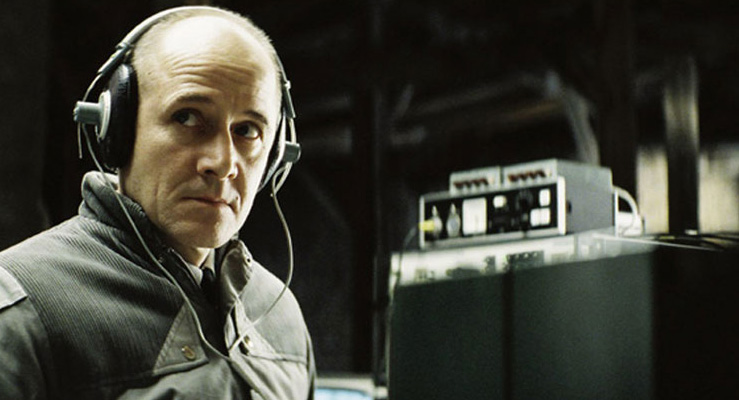
Das Leben der Anderen, The lives of others: reminds us why we are praising the European cinema


The Life of Others is a German film directed, written and co-produced by the so far unknown Florian Henckel von Donnersmarck. It has all the good qualities of a European film. The script even though it refers to a dramatic historical period the last years before the destruction of the wall at Berlin manages to focus on the lives of few people. It has a slow pace that doesn’t tire the spectator but allows him to really get to know the characters and to think on the issues the film presents. Intense colors are missing from the images emphasizing the harsh living conditions. The framing is carefully done and the whole aesthetics of the film reminds us the photographic art of the past.

The script is very good. A spy of the Stagi is commissioned to spy on a theatrical writer and his girlfriend, an actress. He thinks that they ordered him to do this because the writer has ideas against the government. Soon though he realizes that a minister is in love with the actress and he hopes in this way to get rid of his rival. As time goes by the spy gets more and more involve into the lives of the people he spies. He comes to appreciate their ideas their art and the love they share. Eventually instead of doing his job, he protects them and tries to help them by lying to his superiors.

The film is so thick of ideas that I feel overwhelmed in trying to explain and discuss all of them. Still I’ll make an effort to analyze the one that seem more important to me. In order to be able to discuss this film correctly one would have to see it many times and probably keep notes.

The spy is a man who lives alone isolated by the others without love and without thoughts. He has been trained not to think but only to obey his orders and execute them well. Under these circumstances the first think that gets his attention and sympathy from the people he watches is their love and companionship. In his eyes, their feelings and sincerity worth more that the lust of the minister he is forced to serve. The second think that moves him is art as a way of expression of feelings and thoughts. When the writer plays at his piano the Symphony for a good man and tells that no one who can really hear and appreciate this music can be bad the spy is seduced. In this music he recognizes not only beauty but pure emotion. As his life is completely devoid of beauty and feeling he comes to realize that he has to protect these things.

Moreover, the film demonstrates that a regime of oppression breaks the human spirit. People might still be able to go on with our lives, work, earn money, be comfortable economically but the oppression manages to intrude into their most private sides of their lives, into their thinking and into their feeling. The artists are the ones that are both the most dangerous for a regime of repression and the ones that are the most vulnerable to this system. On one hand by their art they can overrule the regime. On the other hand by being forbidden to have an audience or by being secluded and intimidated they don’t have the psychological strength to produce art. The power of art is immense. It can win people over and it can destabilize the government and change history.

Even if the film is quite emotional it manages to escape the melodrama. Subtle moves and expressions of the actors convey all the intense feelings. I appreciate enormously that the film chose a more ingenious end than the one that was obvious and probably be more emotionally satisfying for the spectators. When the writer discovers that he had been protected by the spy instead of meeting him personally he writes a book about the story and dedicates it to him. At this point the spectators feverishly wish a meeting and a dialogue between those men whose life had been so interconnected. They want the moral and emotional satisfaction that a dialogue between these would insure. Instead the director never presents this meeting on the screen. Instead for going for the easy clean-cut ending he prefers a more insinuating one but a fitting one. The spy chose not only to protect these people for their lives and personalities. He chose to protect them for their potential to create art. This is fairly obvious in his discussion with his superior. His superior presents him with his student’s essay about how artist should be dealt by the regime. He tells him that a period of enforced seclusion without physical torture breaks their spirit. The artist that has been treated in this way when they were set free they never tried to create anything again. This would be the future that would be installed for the writer. The spy when he hears all this he chooses to conceal his true report and create a false one. His best reward, therefore, is this new book of the writer.

Monday, January 08, 2007

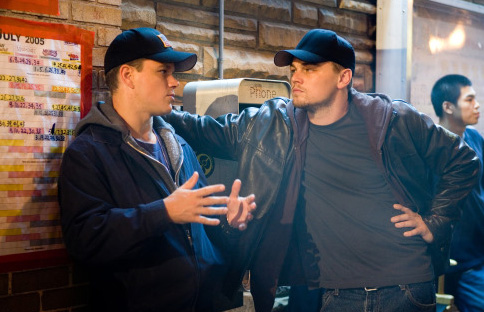
The Departed:A promising beggining and a rather dissapointing end


With The Departed Scorsese has return to more familiar ground and has done what he knows best. A story of battle between the gangsters and the police has offered him the opportunity to create an intense film with style, music and intriguing pictures. Based on a script that begins well and ends up as a disappointment Scorsese managed to prove that he is indeed a great director but failed to create a masterpiece.

It is a pity that a promising script ends up a flop. Still the picture has a lot to offer. For one thing great performances. More important though is that in this film you can still understand why Scorsese is considered to be an important director. He takes the interesting ideas and he translates into interesting pictures. Intriguing pictures both intellectually and aesthetically. He presents the paranoia of modern times creating characters edgy, crazy and scenes clear cruel violent. His rhythm is fast and intense. You go through the film with suspense and apprehension. There is intensity in every second and nothing is redundant

Moreover he manages to capture some astonishing performances form his actors. As usually Nicholson is chilling as a paranoid dangerous man. To tell the truth he is more or less stereotypical in roles like this. Matt Damon does also an excellent job. Leonardo DiCaprio has a difficult but really challenging and advantageous role to play. As the under cover cap he plays a man who is always on the edge. He is afraid of being discovered, and being killed. He is forced to kill and commit atrocious acts that both attract and repel him. And most important of all he is afraid that he has lost his identity that no one will ever no who he really is. On the edge and always on the verge of breaking down and going crazy or killing somebody Leonardo DiCaprio manages to give an astonishing performance.

The script contains some intriguing ideas. Two graduates of the police Academy start their career going into the complete different directions. Matt Damon is his superior’s favorite boy. He seems to work hard doing all the right moves. He rents the nice apartment he finds a girlfriend and settles down and he ascends fast. We soon find out however that he is a double agent as he actually works for the head figure (Jack Nicholson) of the gangsters. On the other hand Leonard DiCaprio as soon as he is out the academy he is attacked by his superiors and driven to work undercover. He goes to jail and eventually he hooks up with the head gangster Jack Nicholson. The two men are presented as the opposite sides of the same coin. Both the criminals and the policemen are represented as similar and equal. It seems that only chance and circumstances has made the one group legal and “good” and the other illegal and “evil”. An idea that is emphasized by Nicholson’s little speech in the begging in the film. He says: than in this neighborhood you can either be a cop or criminal, but when you find yourself in front of the gun what difference does it make. The point is that both groups for their own reasons are capable of extreme violence, are capable of killing. As both Leonardo DiCaprio and Mat Damon are pressed by their real employs to find each other out Scorsese emphasizes the fact that one is the counter of the other. Same and different both containing the dark and light elements they chase each other and both fall in love with the same woman. So far the good ideas of the script are fully developed and Scorsese manages to use them well. As the film moves one those intriguing ideas seem to get lost and the film slips to exaggeration, over sentimentality and a supposedly ironic comment ends up as a cliché. As the pressure on both heroes builds up the delicate balance starts to unravel and the killings begin. One by one all of the central characters of the film die. The gangster Nicholson is killed by his own employee-cup. The supervisor of Leonardo DiCaprio is murdered in conflict. Then Leonard DiCaprio himself is killed and then even Mat Damon is discovered and killed. The last image of the film is a rat on a balcony right in front of the illustrious building of the police academy. All in all the conclusion is rather known to us all: even the good guys are not so good any more. They are corrupted and violent as the other side. In the end the film looses the spectator’s faith in it. Over exaggeration and endless meaningless killing brings all the intriguing ideas of the film o a big of nothing.

Wednesday, January 03, 2007

The Queen: a cute but too mild film


Stephen Frears has created a modest but interesting film that lies between fiction and documentary. The Queen refers to the recent past presenting the political and social implications of Princess Diane’s tragic death.
Queen was a risk. The only ones that had a special interest in its story were the Englishmen. Even those, however could be mortally offended by a film that criticized two of the fundamental institutes of the British country: the royal family and the British Government. Queen however rises up to the challenge and manages to create an interesting plot –even for the rest of the world- and describe both the Prime Minister and the Queen with humor and even sympathy. The social impact of Dianne’s death is described well. As the days go by more and more people come to pay their respects to the dead princess. The Queen however, hasn’t realized the mood of her people and considers Dianna’s death and funeral a personal, private matter. The ambitious and newly elected president, on the other hand, seizes the opportunity and taking advantage of the common feeling manages to gain popularity for himself and his party. As a result a crisis between the two head of British country develops. There is a continuous conflict among the Prime Minister and the Queen. The film manages not to take sides in this conflict. It explains the Queens behavior. She is treated as an old lady used to the ethics and customs of another era, unable to understand the modern times. She is the dignified restricted but still human. The Prime Minister even is the representative of a modern government comes to understand and sympathize with the Queen’s behavior and way of thinking. In the end both queen and Prime Minister manage to come to terms with each other and respect on another.
Frears manages to reach this delicate matter with sensitivity and without insulting any body. In my opinion however he presents a rather over optimistic and naïve aspect of the matter. All the characters are viewed in a positive light. The spectator only gets a small drift of the politics involved in the situation and the possible undercurrents and implications. Moreover the peculiar social obsession with the person of Dianne is scarcely explored or explained. The Queen remains a small cute film but too mild to become something more

Tuesday, January 02, 2007

James Bond: Casino Royale : No plot, great style


Some time ago when it was announced that the actor Daniel Craig would be the next to impersonate the historical and popular character of James Bond most funs of the series started a mutiny. Daniel Craig wasn’t sophisticated and sleek enough for them. He didn’t have the appearance of a man of the world, of a gentlemen. On the other hand Craig’s face has many straight and angle lines that express well the hidden possibility of violence. He is ideal therefore for a James Bond not so well trained to the ways of the world, not so well trained to disguise his true nature, the nature of a raw killer. Eventually most fans, having seen the film have to agree that for this James Bond Daniel Craig was an ideal choice.

The James Bond series usually have basically no story but very impressive and stylish scenes. Casino Royal is no exception. In his first mission as 007 he has to compete in Poker with the terrorist Banker and win. The first half the movie builds up to the poker game. Then the rest is about James Bond’s love story with his colleague from the British government. As the action flows in the first half the film is bearable but when the romance starts the script falls form the one cliché on to the other. The fact that James Bond, the notorious womanizer, fells in love is a first for the character and the series. From the begging of the film a suspicious viewer can tell exactly how this romance will develop and end. Supposedly this film and this story is the one that sets and justifies the characteristics of James Bond personality, the fact that he uses women and expects betrayal from their part.

Leaving the plot aside we come to the good parts of a James Bond film: the stylish aesthetics of the film. The first sequence before the titles is surprisingly good. Filmed in black and white, with high contrast and deep shadows reminds us the noir style of the late 40s. The noir style however has a modern clarity with cold tint than couldn’t be achieved with the film equipment of the 40’s. I thought the idea of adopting the noir style for the sequence of the past was quite ingenious. The specific style is well connected in the minds of the educated spectators with the late 40’s and early 50’s and it signifies the particular historical era, when the cold war arose. Lets not forget that James Bond as an agent is truly the product of the particular historical circumstance.

Another astonishing sequence is the one of the chase. This sequence replaced the most spectacular sequences that traditionally set the beginning of the story in the Bond series. Instead of the ludicrous scenes of the land Bonds where the hero used to jump off a cliff and catch the plane, or doing wind surfing on melting icebergs, the scene of the chase manages to be impressive believable and not at all ridiculous. The chased man is done by an athlete specialized in running with acrobatic moves in the city landscape. The fact that he actually does what he is filmed doing makes the sequence seem more realistic and therefore more impressive. The editing in the specific scene is superb creating the intense rhythm that a good chase scene demands. The third impressive element in the film is the titles themselves. Titles also have a long history in the series. They are always highly stylish, long and accompanied by a song that automatically becomes classic. The titles of Casino Royale play with the symbols of the cards. Highly graphic with intense colors, I believe, are probably some of the best titles ever.

All and all for a Bond film Casino Royal is pretty good. Even it practically has no plot aesthetically manages to create an interesting proposal and renew the Bond series. Darker and more realistic than the most Bonds succeeds at surpassing the period of the self parody and ludicrous excess that characterized the Bonds of the 90’s. Casino Royal is definitely not a good film but it is a good Bond film. Have fun!

AFTERNOTE
Check the first sequence in the noir style and the titles...

The Wind that shakes the Barley: A historical melodrama that fails to sustain its inner meaning


The new film of Ken Loach is narrating a part of the history of Irish and British combat. It starts demonstrating the British regime of violence and oppression that eventually pushes the Irish peasants over the limit and drives them into resistance and action. Young boys, farmers are trained by IRA in order to sabotage and kill English soldiers. Killing the others, the Englishmen, is relatively easy for these lads that have been filled with hate and anger after years of mistreatment. Eventually the English army withdraws. A new conflict begins- this time- among the Irish. A civil war is always described as a war between brothers and this is also demonstrated in the Ken Loach film. The two brothers- the main film characters- take the opposite sites and the one is eventually executed by the other.

The story of Ireland has been fairly developed and exposed in film. In these films even a foreigner can read the signs of a very painful history and sense that the scars haven’t faded away yet. The well-directed story of the recent history of Ireland might be a good film by itself for those who have a special interest and emotional connection to the particular historical period (Irish and British) for the rest of the world though something is missing. Everybody knows that a war is a painful situation and that a civil war is even worse. Most of us suspect that in these circumstances right is lost. All sides have their own right. Why do we need another film to state all the same old and familiar truths?

Ken Loach manages to impress on his film all the markings of a good director: beautiful images, careful framing, suspense and good rhythm, emotionality. The film however has a fling for melodrama, and ends up being a little bit vacant. When you watch it you are sufficiently drawn into it but when the film finishes what does remain? Unfortunately nothing lingers. Ken Loach fails to create a film that will take all these well-known and accepted truths and make us see them in a new enhanced light, make us think them over one more time, experience again and acknowledge them from the beginning. It is a pity because these truths are really important and we shouldn’t forget them or take them as given.

Monday, December 11, 2006

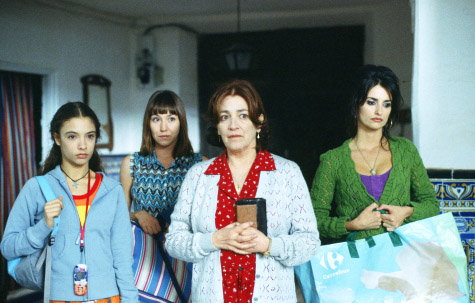
Volver


The newest film of Almodovar is called Volver, which means turn back. In this film he uses at the central role one of his favorite actresses, Penelope Cruz. For one more time Almodovar is focusing on women. The central theme of the film is the relationship between mothers and daughters. After her death, the mother returns to resolve the issues she had with one of her daughters. In the mean time her daughter (Penelope) is trying to put her life into order. She tries to hide the body of her lover, who was murdered by her own daughter when he tried to murder her, to earn some money and get on her feet again.

Almodovar always had a flair for soap opera, surreal and kitsch. As the years go by I feel that his aesthetics change into a milder tone. The extravagant and the high tones that accompanied his older films like Kika or the Women on the Verge of a break down have faded away. Strong colors and even glamorous lighting remain as a symbol of the culture of Spain, but the kitsch has definitely departed. Moreover the surrealism and irony of his older films has also mellowed down. Hints of his old sarcasm remain but are not so obvious anymore. In this film for example there is a scene of criticism against the talk shows that are popular on tv these days. A woman who suffers from cancer is invited to talk about he scandals of her village. A hot subject for a tv show since sex and murder is included. When she refuses to reveal her secrets the show woman reminds her that her reward for the shown would be a treatment for cancer at Memorial. The problem is that the more his film become mild and aesthetically pleasing, the more they resemble to a soap opera. His scripts always referred to issues that could well be the central theme of a soap opera: family problems and erotic relationships. Irony and surrealism managed to differentiate his film form the tv-series. His new glossier style has made his films easier to watch and acceptable to many people that were appalled by the extravagance of his old ones. Is this necessarly a minus, though? Why should a worthy film be a difficult film? If Almodovar manages to convey his messages with a milder tone why shouldn’t he?

I enjoyed Volver. I enjoyed the fact that it begins in a surreal, metaphysical way taking us "hostages" in its narration and making us believe at the supernatural only to end up in a completely logic and natural explanation. I like the fact that the film had cleverness in its script. It conveyed clearly the feelings of the people involved in the story, and ends up with a healing touch. On the other hand, I miss some of the sheer audacity that Almodovar demonstrated in the past. If Almodovar could combine the new aesthetic with the irony and surrealism of the past, I personally would be a happier spectator. Volver, however, remains a good and an enjoyable film that is worth seeing.

Monday, December 04, 2006

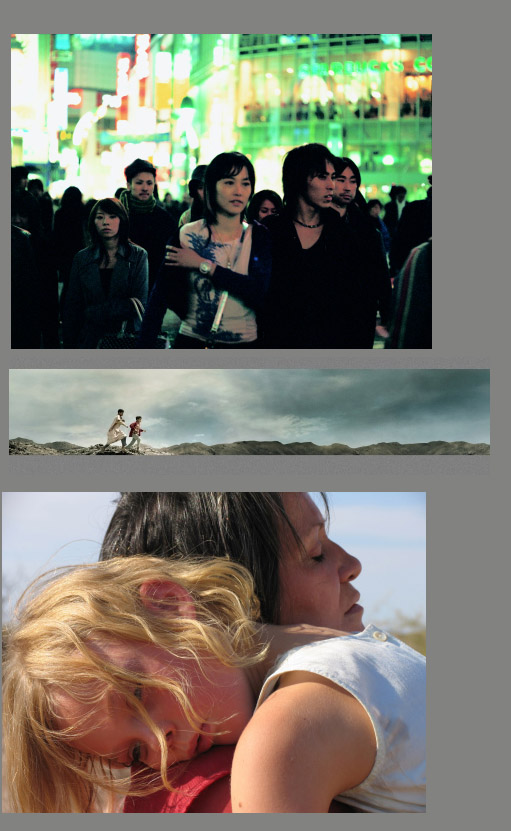
Babel:a story about communication and understanding


Alejandro González Iñárritu’ s new film has the same style as his other films (Amores Peros, 21grams). Babel his latest film is also the story of a story of intertwined events. A woman-tourist in Morocco is shot. While her husband tries to take her to a hospital and save her life we see in flash back the problems the couple had. Moreover we follow he story of the Mexican nanny of their children who is accused of kidnapping them and is exported back to Mexico and the story of a deaf girl in Japan who lives with her father after her mother committed suicide.

The editing between the three stories is ingenious and has great rhythm and pace. It manages to create tension and anxiety and maintain it throughout the whole film. The film has the personal style and aesthetic of Inarritu. Sharp images that convey the culture and the way of living in four completely different countries, Morocco, Mexico, Japan and United States.

The connection between is rather loose and has no real meaning. The meaning of the film could have been served equally well by three completely separate stories. In all cases Inarittu explores cases of miscommunication and misunderstanding. The couple of Brand Pit and Cate Blanchett have failed to communicate and understand each other after the tragic death of their baby son. They take the trip to Morocco trying to be alone and to re-discover each other but it takes am almost fatal incident (the shooting of the wife) in order for them to be able to really talk and resolve their past issues. The play of the children with the shot gun is mistaken for a terrorist act. As a result the relationships between America and Morocco suffer. The Mexican nanny takes her charges along with her in Mexico for her sons’s wedding. When she tries to cross the borders back to America the border patrol thinks that she has kidnapped the children. Her nephew that drives the car feels threaten and from there and on everything goes downhill. The children are abandoned in the desert, almost dying from thirst and the nanny is deported back to Mexico and is treated as criminal. The initial misunderstanding that leads to destruction in this story takes place in the conversation between the border patrol and the nephew. In the third story a girl is trying to communicate without language. She is deaf and mute. Even in this case the results are not very encouraging. The girl misinterprets human contact with sex. In all cases fear and prejudice uphold communication and understanding. An accident with a gun is thought to be a terrorist act because terrorism is expected from Arabs. The Mexican woman is treated like a suspect at the border and fear leads her to some unwise decisions. Only the children who haven’t learned to be afraid or to be suspicious remain unconcerned and are ready to socialise at the wedding and have one. Only when the police start to go after them do they start to feel that their nanny might not be such a good person after all. The obvious conclusion of the film is that fear and prejudice lead to misunderstanding and even to violence and war. A rather obvious conclusion, wouldn’t you say?

All and all Babel is a well thought film. It has the signs of a true auteur. Inaritu definitely has his own style and his own agenda, which is a good thing. On the other hand, and this is the only complain i have about this film- Inaritu has done this kinf of film again and better. Somehow Babel fails to communicate in an inner level with the spectator. It remains a good film but a rather cold film. A film with great intellect and less feeling.

Thursday, November 09, 2006

The Children of Man: a great idea became a mediocre film


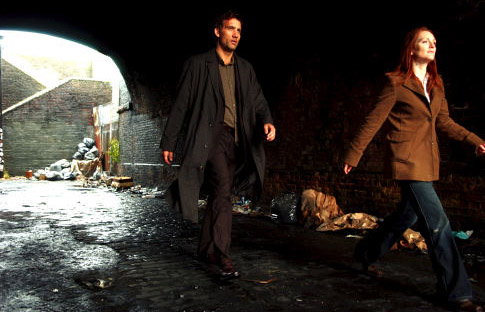
In the year 2027 the youngest man on the planet is eighteen years old. Scientist can not understand why all women have become sterile. In a society with no hope and no future everything has collapsed. Violence has taken over the entire world. Only Britain stand thanks to a totalitarian government with no humanistic reservations. All refuges are hunted down, closed in concentration camps and eventually exported. Our hero leaves a dull life. Once he had a child and a wife. No the child is dead and the wife is the leader of a terrorist group fighting for the rights of the refugees.

Suddenly the hero is contacted by his wife who asks him to use his connections in order to make some travel card for a girl refugee. While they make their escape plans the wife is killed and the hero is left alone with the girl. At that point the girl reveals to him that she is pregnant and she is trying to keep it secret because she is afraid that they are going to get her baby away from her. In these circumstances the bay is the hope of all people, a flag for political causes a valuable asset.

As usually actors do their job well. Unfortunately Julian Moore is killed at the beginning and the audience is deprived of the presence of one of the best woman actors of our times. Photography is well thought. Grey tones and earth colors rule the images transferring the hopeless and pessimistic feelings of humanity. Directing is more than adequate even it can be said that is doing something really inventive or majestic.

The film starts well with a good idea. The point that children are humankind’s hope is overstated. I don’t think that anyone would argue differently but the film makes a great deal of effort to prove the self proven As the film moves along, it can not resist all the possible connotations that spring into the mind from the image of a young woman with a child. Soon enough she is rendered as Madonna. People stop fighting in order to let her and the baby pass, they cry, they knell and pray. Moreover, the atmosphere in the beginning which is very convincing as dissolute, passive, futuristic in ends up in a religious, melodramatic and superficial episode.

This film had the perquisites to be a futuristic-classic. Along the way though traded some of its most intriguing characteristics for a religious, apocalyptic feeling. In other words it ends up as a typical Hollywood film. All loose ends are tightened, sacrifice is rewarded, and hope is restored. Unfortunately a film that could lead to some inner-thinking and worry and leaves us content and pacified.

Monday, October 23, 2006

Black Dahlia: Read the book Forget the film


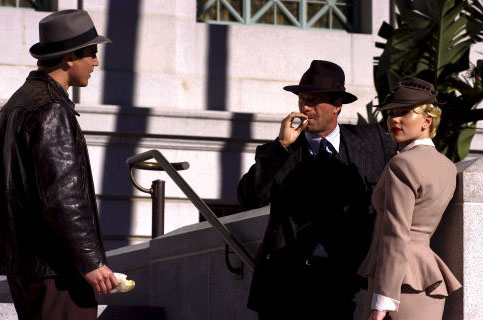
The script is based on an excellent book of Elroy which is considered a classic of the detective series. The director B. De Palma seemed ideal for realizing this project. His long admiration of Hitchcock and his career on mystery film create the impression that the project would be well executed. After all these facts one can only wonder what went wrong.

Every time a book is transferred into screen there is a great risk. Will the film be a able to concise the usually extended plot of the book maintaining the important parts and keeping the necessary coherence? Will it manage to transfer the atmosphere of the book? The more known and loved the book the greater the risk. In Black Dahlia’s case the film ended up with no atmosphere and no twists and turns in the plot that would have made the film interested. Everything was flat. The murder story was no sensational. The love story wasn’t believable. The sexual story wasn’t intriguing. Even worse De Palma’s directing never leaves the boundaries of convention. Where are the pictures that were so perfectly though and planned that became fetish for his funs. Where are the shoots that imitated Hitchcock’s cunning? A complete disappointment. A good opportunity for a sensational film has gone into the drain. In other word read the book and make your own film in your own mind.

Monday, October 16, 2006

Thank you for Smoking! : a satyrical comedy, fun enough not mean enough


The Thank you For Smoking is a good comedy but a light a satyr. The story is about the spokesman of the tobacco industry in USA. In the modern society of America that smoking is not politically correct anymore. One man (most hated) is responsible for the public relationships of the tobacco companies. His job is to think fast and talk even faster. Most people hate him for what he does for a living and consider him nothing more than a murderer. On the other hand he says that all people know that cigarettes are bad for their health but they are entitled to choose fro themselves whether they want to smoke or not.
The film and the situations are represented with humour. The film has a good pace keeping you always interested and alert. The actors are great in their part and the filming is well done. Still there is something missing. A little more irony would be welcome. The film makes an effort to depict
t the hysteria that hangs over America about what is right and healthy and as usually they are going overboard. The comments remain relatively innocent lacking the acid that would make them even more deliciously clever and hilarious. As I said before the pace of the script was fast. In some cases too fast as it doesn’t take fully advantage some of the cleverest ideas of the film. For example our hero gets kidnapped and is filled with nicotine patches. His doctor informs him that being a smoker has saved his life, but he can’t smoke even one more cigarette because he has taken an overdose of nicotine and he will die. From there and one we never see the hero struggling to cut down cigarette. The point is lost in the current of the film.

Eventually I would say that Thank you for Smoking is easily watched and well enjoyed but remains superficial since it lacks the cutting edge that would turn into a classic.

Tuesday, October 03, 2006

Miami Vice: am unsuccesfull action film


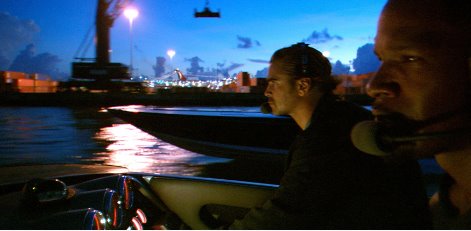
There are many reasons to go and see a film. And then again there are equally many to no to. Sometimes you go in order no to stay at home, or in order to to see your friends. Other time you go because the film is advertised a lot and you want to have an opinion of your own and so on. But when do you to cinema for the "right reasons"? Healthy-eaters say: you are what you eat. For me you are what you see (listen and read). If you eat junk food you will eventually get unhealthy. If you see junk you will eventually get stupid. The problem is that in your house on tv the options are limited. You are force fed junk. So when you go to cinema you make an active choice and finally you can choose something good for yourself. On other hand people have cravings for junk.
So I went to see Miami Vice. My friend wanted to see it since he felt a bit nostalgic for the old tv series and well i accompanied him. The film iamges are well thought and executed. In other words it has style. The film starts with a question: who informs the bad guys about the undercover works of the fbi. Usually when a question is made in the beginning of the film, the narration has to give answers in order for the film to be concluded. In Miami Vice case though, after all that style and a little bit of action and love story in the mix the question remains open. we never find out who is the snitch. There are two possiblities. In the first case they forgot about it. I mean who would notice that the film wasnt finished! then again maybe they are already planning a part two. Anyway the whole film was ridiculus. It had no real script. In the end i felt rather disapointed and deceived.
Next time no junk food for me it gives belly ache.

Tuesday, September 26, 2006

Corespodence from Athens Film Festival 1: The Treatment, Paprika, Lights in the Dark, The Brick

The International Film Festival of Athens began on 20th of September. As a serious movie-goer I made an effort to see as many films as I can. Usually I try to see films that rare, old or from directors that i don’t know. My goal is to use every festival as an opportunity to see and get to know new things. Sometimes though circumstances force me to see films that i wouldn’t prefer seeing in a festival. My time schedule is tight or there no tickets left for the show i chose at first place so i see something else instead and so on.

So until now from the numerous films I' ve manage to see the following four: The Treatmnet- Oren Rudavsky, Paprika-Sotashi Kon, Lights in The Dark-Aki Kaurismaki, The Brick-Rian Jonson

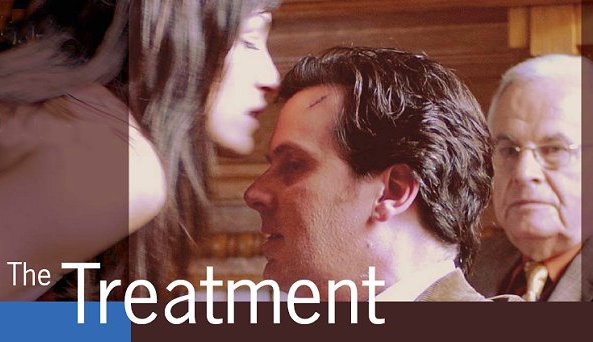
The Treatment

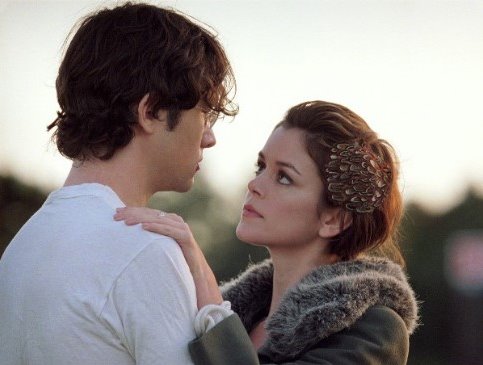
A middle-aged man, a literature teacher is facing problems with his sexual relationships. He isn’t able to let go his past girlfriends and connect emotionally and sexually without remorse with a woman. In order to deal with this problem he visits a therapist who insists that all his problems derive from his relationship with his mother. A recently windowed woman expresses her interest in and he collapses. He doest know how to treat her and he is afraid that he is going to get hurt from thei relationship. Suddenly he realizes that therapy isnt helping all that much.
A modest film that is heavily based on the good acting of both its leading actors (Chris Eigement and Framke Jansen) and its clever dialogues. The humor on erotic relationships is insightful and bittersweet. In most jokes the audience laughed knowingly since it could completely identify with the situation and the characters.
Simple and modest this film wins you over by stating two-well known facts that sometimes we all forget: people have too many inhibitions and are stuck in their past. These mistakes can cost you your happiness.

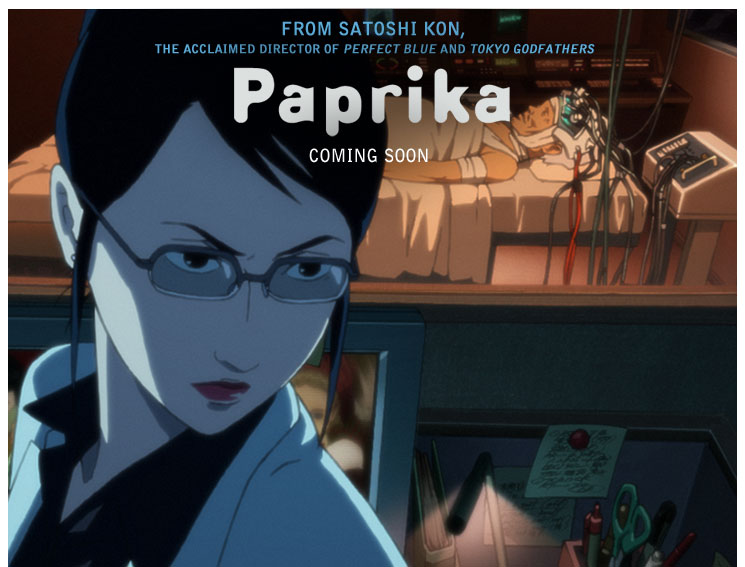
Paprika

Paprika is an animated film with adult characters and an adult scenario. Scientists have invented a machine that allows the psychiatrists to enter the patient's dreams in order to help him find out what is troubling him. The machine, though, is still experimental and it is forbidden to use it. A girl named Paprika uses the machine in secret in order to help people by accessing their dreams. The machine though is stolen and misused. The one who stole it creates dangerous hallucinations and drives people crazy. He tries through people's dreams to control them. Paprika with the help of the scientific staff and a detective manages to put a stop to this dangerous terrorist.
The animation is done quite traditionally. No 3d effe, not very extended usage of the computer possibilities. As a result the comic has a nostalgic, more traditional Japanese feeling in it. It remains aesthetically perfect, full of original design, colour and fantasy.
The script is completely adult. It has so many twists and turns and everything happens so fast that it is difficult to follow. to tell the truth the scrip isn’t so original. The idea of entering someone’s' dreams with dangerous results has been exploited in the past (The Cell comes immediately to mind). I appreciated the fact that the sexy lady ends up with the ugly fat guy instead with the action male figure. Such deviations from the usual route entertain me.
In this film thought the animation and the images are more important. The images manage to remain in your head for some time after
the movie and that means a lot.

Lights in the Dark

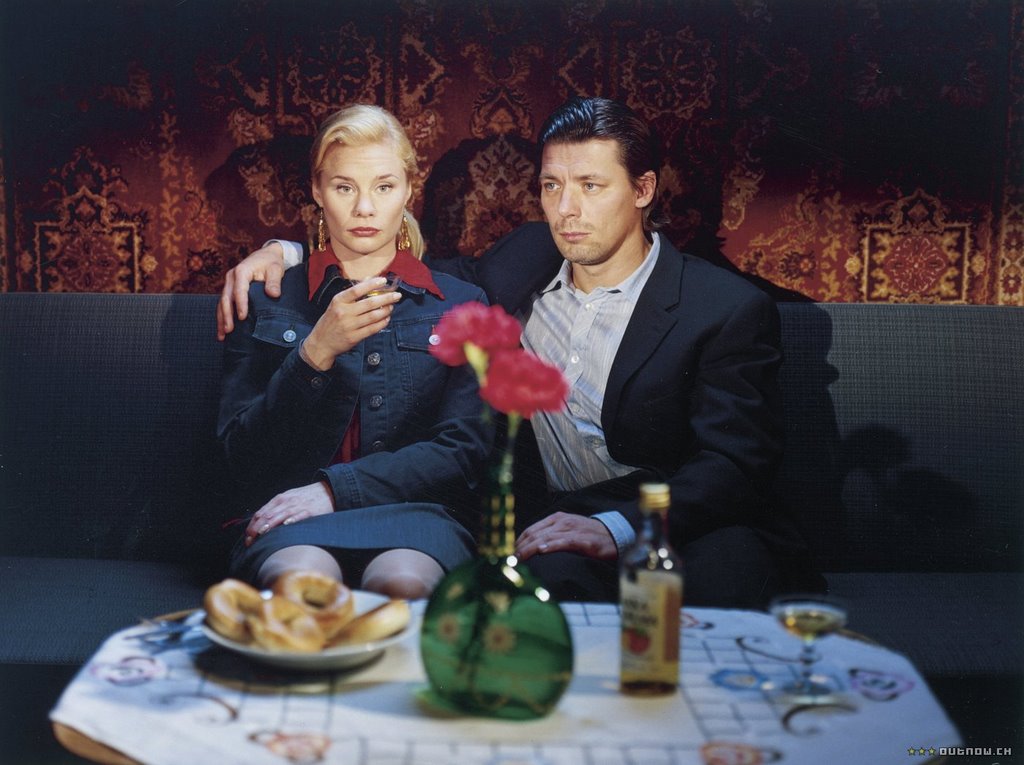
Several years ago Kaourismaki gained a spot in my heart with his film A man without past. From there and on accepting anything less from him has proven difficult. Unfortunately his latest film Lights in the Dark doesn’t measure up, even if it remains a good film.

A night guard falls in love with a beautiful girl. She however, uses him in order to learn the security codes and steal a jewellery shop. He is accused for the theft and sentenced to prison.

Kaourismaki describes Helsinki as a place of poverty and despair. All human touch and dignity has been lost. Can Finland really be so bad? The hero, a good but socially awkward man is hit and destroyed. When he seems in the ropes end though he manages to still pick up himself and continue. Everything good he has done is coming back to help his stand on his feet and resume his life. Kaourismaki for once more he declares that even when everything seems black people can make it.

The script is not original. It has no twist and surprises. A common story in film noir (boy meets fatal girl, he falls in love and he is destroyed by his love) is used here with a different angle. Destruction itself is not important. What counts is the fact that this man at the downhill of his life still struggles and goes on. Through simple means and scarce dialogues Kaourismaki manages to create atmospheric pictures and convey sufficiently the mood of a hard society that drives people to their edge. The humour though that emphasized the hidden but strong optimism of A man without Past is not at its best. To those who haven’t seen another Kaourismaki film my advice is to go and see this one and then search to find previous work on dvd. For the rest Lights in the Dark is still a more meaningful way to pass an evening than watching tv or a Hollywood film.

Brick

A noir film with all the right elements of the style filmed though at school with teenagers. A paradox that works all right.

Emily-his ex girlfriend-calls Brian asking for his help. After two days he finds her murdered and tries to find out who killed her and why. A whole subterranean universe is revealed under the innocent environment of the local college. Crimes, drugs, sexual manipulation and so much more characterize a dangerous slippery environment where getting involved with the wrong kind of people might prove fatal. Parents are absent. They are just an obstacle to handle or completely oblivious to their children’s criminal activities. Teachers and the principle have taken the place of cups. They are not interested in truth. All they want is to look good and implant a resemblance of order.

Brian the hero is a young Humphrey Bogart. He has a weakness for pretty girls that they exploit. He is tough and clever. He is beaten heavily throughout the film and he endures and goes on until the end. The femme fatal is also here. A beautiful rich girl, a manipulator. She might not commit the act of murder herself but she manipulates the others to do it for her. She is a player. She seduces our hero and in the end she takes from him he is only comfort. The girl he loved, the girl for who he did everything didn’t love him back.

The script is really complex. It surprises in every turn as a James Elroy novel. The problem is that all this happens in a school! That all these corrupted people are teenagers! But is it really a problem? Rian Jonson was clever enough to use this element into his advantage. The film is a tribute to film noir without taking itself too seriously. A sense of humor and a light sarcasm penetrates most of the scenes. The drug dealers drink a glass of milk while waiting for the war between the gangs to begin. The mother of the big boss-drag dealer offers apple juice and cornflakes to the heavily beaten hero without asking him how he ended up all bruised up and so on.

Brick is a fun clever movie appreciated greatly mostly by funs of the film noir. See it as an inside joke, It is a film of an amateur. He loves what he is doing and that shows. On the other hand he still has a lot to learn in order to create a film like art. Go and see it, have fun but expect no more than that.

Trivia: The horn signal Brendan has Laura give him (long, short, long, short) is the same as the knock Sam Spade tells Brigid O'Shaughnessy that he'll give her as a signal it's him in The Maltese Falcon (1941).

Comment:

Oliver if you are out there reading this ….go to see this film it will remind our Essex days. This is what our film would be like if we had more time and money


Wednesday, September 13, 2006

Γλυκός Σεπτέμβρης με Νύχτες Πρεμιέρας


Μετά από σχεδόν 2 μήνες αποχής από τις κινηματογραφικές αίθουσες παρακαλούμε για μια αφορμή ώστε να επιστρέψουμε στα γνωστά μας στέκια ανανεωμένοι. Κάθε Σεπτέμβρη η αφορμή αυτή δίνεται από το φεστιβάλ Αθηνών "Νύχτες Πρεμιέρας". Τέσσερεις αίθουσες -από τις πιο όμορφες της Αθήνας προβάλλουν για 12 μέρες ταινίες πολύ-αναμενόμενες (Μαύρη Ντάλια, Volver του Amoldovar, Miami Vice) για να μπορείς περήφανα να πεις οτι το είδα πρώτος, περίεργες και σπάνιες, για τους συλλέκτες του είδους, και μερικές εκπλήξεις που τελικά χαρακτηρίζουν το φεστιβάλ και –ευτυχώς !-σου θυμίζουν ότι υπάρχει σινεμά και εκτός Hollywood.
Τέτοια εποχή ο φίλος μου, ο Γιάννης κάνει πάντοτε την ίδια ερώτηση: Ελένη τι θα δούμε; Τα πολύ-αναμενόμενα και αγαπημένα τύπου Almodovar ή αυτά που εκ των προτέρων ξέρουμε οτι δεν θα βγουν ποτέ στις αίθουσες; Στην περίπτωση ενός άγνωστου σκηνοθέτη παίρνεις το ρίσκο να δεις κάτι που για σένα τουλαχιστόν θα είναι βαρετό και απαράδεκτο. Σε παλιές καλές εποχές που είχαμε χρόνο τέτοιο δίλλημα δεν θα υπήρχε. Λίγο πολύ όλα θα τα βλέπαμε. Τα τελευταία χρόνια όμως απαντάω σταθερά ότι προτιμώ να δω ότι έχει λιγότερες πιθανότητες να βγεί κανονικά στις αίθουσες το χειμώνα. Καταρχάς τα υπόλοιπα, τα διάσημα έργα μπορώ να τα δω με την άνεση μου στον κινηματογράφο της γειτονιάς μου. Επιπλέον τις μεγαλύτερες συγκινήσεις τις προσφέρουν οι εκπλήξεις από σκηνοθέτες, το όνομα των οποίων αγνοούσες μέχρι τη στιγμη που τους συνάντησες στο φεστιβαλ. Έπειτα ένα φεστιβάλ οφείλει να σου ανοίγει νέους ορίζοντες, να σε φέρνει σε επαφή με το σπάνιο και το διαφορετικό. Ναι θα μου έλεγε ο Γιάννη, αλλά το φεστιβαλικό κλίμα στις πολύ-αναμενόμενες ταινίες είναι ξεχωριστό. Άσε που μπορεί να πετύχεις και τον σκηνοθέτη στην παράσταση και γίνει καμιά συζήτηση....Καλή και αυτή η άποψη.
Όπως και να είναι πάρετε πρόγραμμα, πηγαίνετε 1 ώρα πριν στην αίθουσα (και λίγο λέω) και πιάστε θέση. Το φεστιβάλ αρχίζει…

Σχολιο
Για περισσότερες πληροφορίες http://www.aiff.gr

Wednesday, July 19, 2006

The Inside man, MI3, Xmen , DaVinci Code


After a long absence i come back to share with you my opinion about the last films i saw before the endless void of the summer period.
Just before winter cinemas close and summer one open there is a short period where acceptab;e films come out. some of them are heavily advertised but when they do come out have littel to offer. Best case scenario they would offer an ecxellent dvd night at home with friends.
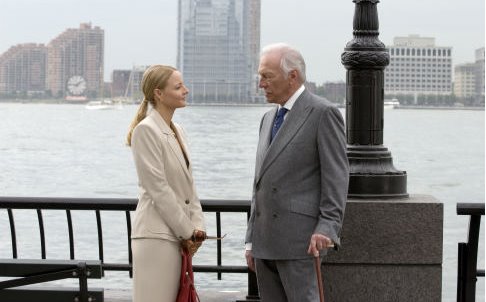
The Inside man
Going from the best to worst I will begin with The Insider. In the long tradition of films describing an ingenious robery Insider has little new to offer. It remains a well written, played and executed film. The clever twist of the story is that the most important role in the plot is not the robbery itself but the question of what the owner of the bank hides in his own deposit box. Jodie Foster -excellent in her role- as always takes on the responsibility to retrieve the mysterious contents managing at the same time to keep this content a secret. Finally we get to see foster in a role worthy of her ability and talent. Even though it is just a small part it is subversive enough to gain the attention of the spectators. Contrary to Hollywood trandition here is a woman dynamic ruthless that even if she is beautifull and attractive manages to play the men's game at equal terms!
The film has good rythm maintaining the suspense untill the very end. Clever scenario, good acting and good directing have managed to create a film that is a great example of what kind cinema Hollywood can offer at its best. Great spectacle that doesn underestimate our intelligence.
X-men: The Last Stand
The most recent film of the Xmen manages to keep up with the standard of the previous films. Even if it is nothing extraordinary it remains a well thought and made action film. The thrid Xmen summarises a circle of episodes that remains as ine of the most beloved one between the funs of the comic series. Jane Grey is reserected as the Dark Phoenix and turns against her friends and lover Scott Sammers. In the end Wolverine-also in love with her- has to kill her in order to stop her. Suprisingly enough for a Holywood film there is no happy ending. Most of the spectator's favorite characters die and remain dead: Scott Sammers, Professor Charles Xavier, Jean Grey. Even if the good guys win and are some optimistic note in the end what is the cost of victory? The film is fairly pessimistic.
Mission Impossible III
Mission Impossible III strats promisingly and ends as mediocracy. In the first scene Mr. Hunt watches his girlfriend being assasinated. The film rewinds to let the spectator know how things got to that point. Therefore as Tom Cruise plays the hero the spectator has a fear that the end wont be a happy one. Action gets louder and louder as the film goes on. Eventually we get back to the first scene where this time we find out that the girlfriend murder was just a ruise. The girlfriend is saved and proven worthy of Hunt's love since she manages to kill some of the bad guys on her own. So far so good. All the educated spectators expected so much. In this point, however, the script overdoes it. Tom Cruise dies and gets back to life. Ok you can sustain you believe but sometimes there is beaking point. When a film surpasses this delicate line the spectator feels manipulated, tricked and eventually dissapointed.
Da Vinci Code
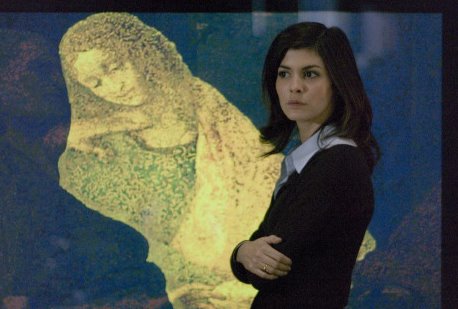
We come to the most advertised film of the period. The big success of the book drove Hollywood to exploit some of that popularity. Ron Howard is director that even hasnt shined has made well some of films that met reasonable success (Cocoon, Runsom, Beauifull Mind). He was a safe choice. The script was an accurate and successful adaptaion of the book since it managed to summarise the plot maintaining some coherence. The actors that were chosen were famous and love by the audience. Tom Hanks might no be one of my personal favorites but he remains a well accomplished one. On the other hand Jean Reno and Audrey Tautou were inspird choices. The film though remains a dissapointment. It has no rythm and doesn't manage to create suspense. Most of the book's action is spiritual and not physical. The book manages to enchant through the boldness of the historical connections and the mystery of the conspiracy theory. The film doesnt manage take advantage of the mysterious atmosphere of the book and downplays the spiritual action in favor of the physical one. In the end a void film results.

Thursday, May 04, 2006

Crash: a film about racism


Crash was the Oscar outsider. When all thought that the Secret of the Brokeback Mountain would get the Oscar of the best movie, the comitee decided to play it safe and 0offer the prize to a more "politically correct" film.
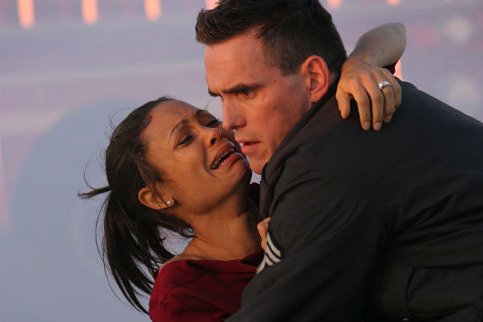
Crash is consisted of several interlaced stories which are discussing the problem of racism in Los Angeles. Stories of violence, murder, hate and suspicion prove that ordinary people with plenty of good character traits can be capable of the worst. Even the most positive character, one who complains against the racistic behaviour of his partner ends up killing a young black boy becouse he is afraid of what he is going to take out of his pocket. On the other hand the most negative character ends up doing something heroic. He ends up saving from a burning car the white woman that he molested sexually the previous reason only beacuse she was married to a black man. The film proves that in a community so multi-cultured as the on in Los Angeles, the rascistic past of America weights heavily. Moreover it insinuates that fear rules every human relationship. The media through their constant report on crimes committed by people not white have managet to create an atmosphere of fear mist trust and suspicion. Eventually it is this atmosphere that gives to birth to more cimes and killings and not racism itself.
Crash is well made film, with good acting and a clever scenario. Its theme is definetely one of the most important problem of our times. It leaves though a scarse hope, light for the future. While the best end up being murderers and corrupted and not one act of mercy and humanity is presented, you end up leving the theatre feeling definetely out hearted. Crash presents a viscious circle with rare chances of break and in the end doest manage to inspire any higher feelings to its spectators.

Tuesday, April 25, 2006

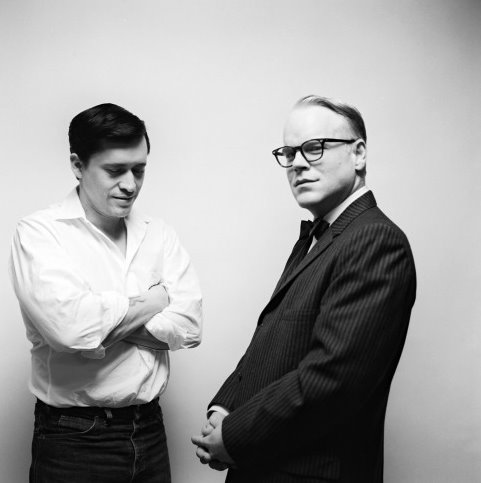
Truman Capote


This is a film about one of the dubious personalities in the art field of the 20th century. Truman Capote managed to write one of the most dramatic boos taking advantage of people and wishing for their execution.
The spectators follow this conflicitve personality through the creation of the whole book. From the start when Capote first got interested in the killings untill the end, the execution of the killers by hanging. Capote sometimes seems to really care for the men that did the atrocious crime trying to find them proper lawyers to defend them and talking to the for hours. Other times he lies to them in order to get the material he desires for his book and wishes they are executed in order to be able to finish his masterpiace. In the end the killers are killed by the state and Capote manages to write one of the most sucessfull books of our era.
The film is well made. The spectator can easily watch it and enjoy. Hoffman manages to convey the special traits of the character he impersonates. Capote was a homosexual, insecure person with plenty of personal problems. Hoffman through hiws way of talking and facial movments proves he studied his hero well and managed to imitate it faithfully. In the whole, however, the film is mediocre, since it has nothing new or ecxeptional to offer.
Eventually, the film raises a question. An artist, a writer always gets his inspiration from the lives of other people. In some way, exploits their feelings and experiences in order to create something great, a piece of art. In Capote's case this expoitation is explicit while in most cases the spectators do not realise it.Up to what a point is this expoitation justyfiable?

Friday, March 31, 2006

Syrianna: a political comment on contemporary American reality


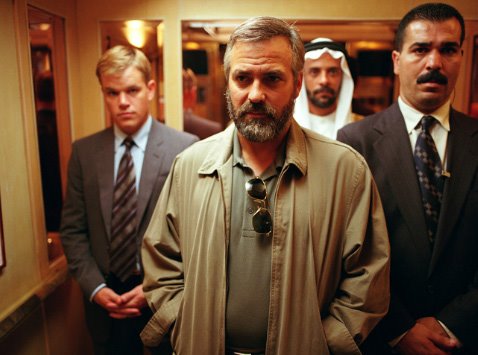
Syriana is a political thriller about things we strongly suspect. For the Americans this film can be a shock but for Europeans the inter-relations of politics and companies that handle petrol distribution is an old secret. Three different stories are narrated. From one hand, we follow the story of an agent, an assassinator- to be exact- of the United States. On the other hand there is a member of an important petrol company who tries to negotiate a big deal with an Arab Prince about the petrol production of his country. The third story is about a lawyer who is investigating in order to find out if a small company managed to close a deal through unjust means. All theses stories collide at the end of the film with the assassination of the enlighten Arab Prince by the USA Government. Corruption is presented in every level. The government abandons its assassinator when he is exposed. The lawyer covers up the foul playing he encounters. Big companies manage to ensure who will ascend next to the Arabian throne. In this chaos Americans act against Americans and nobody knows what the others do. In the end the situation is not beneficial even for the American state.
The story is quite complex and the spectator cant follow the thread of the three stories easily. In the better part of the film he tries to orientate and find out in which country he is and what the political situation the film describes is. The film is fictional but remains so close to reality that has a documentary ring to it. You have the strong feeling that the things it describes have actually happened.
In the end Syriana is a clever political comment which has nothing new to offer to the European audience. However, it might be an insight of Americans foreign politics for the country's audience. As a film, though, it lacks coherence, clarity and inner meaning. The great acting form Clooney and the intelligent subject manage just to save the movie and place in meritocracy.

Friday, March 24, 2006

Cache: The Hidden- An anigmatic film


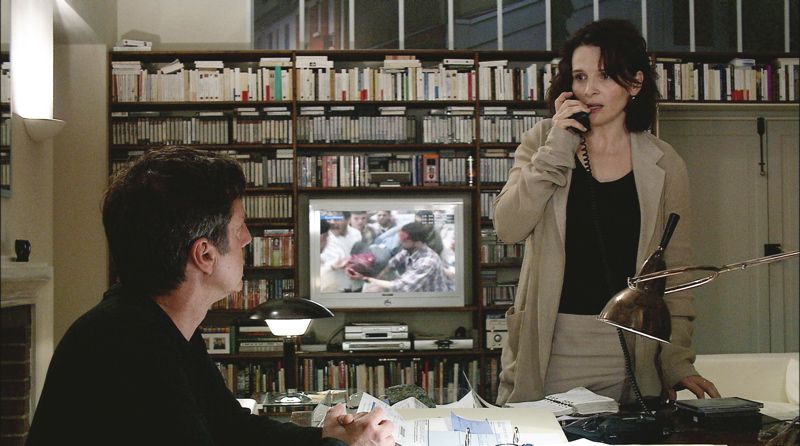
I consciously let some time to pass by before attempting to write a review on this french film. Firstly it is hard to decide whether i liked the film or not. Then it is even harder to try and explain it. A completely confusing piece of filmaking.
Haneke is a director with interesting past. A director whos is considered a good example of the European cinema. In the film he selected a group of ecxellent actors, Daniel Auteuil, Juliette Binoche who manage to capture the audience through their ecxellent acting. The film presents an upper class family who suddenly starts recieveing videotapes that have recorded their house and part of their everyday lives. along with the tapes come childish drawings which represent a hurt boy. The husband begins to suspect that the tapes and drawings are sent by an algerian boy that his parents wanted to adopt. He as a boy had managed to prevent the adoption by lying and deceiving his parents. As the movie moves along we meet the situation gets more and more complex. In the end we never learn who actually sen those tapes and why.
Cache is definetely a weel educated film on the art of cinema. The spectator finds it difficult to tell apart the scenes that are part of the tapes and the scenes that are from the actual film. The element of scopophilic value of the cinema is well documented and explored.
I think that the director is trying to make a point on how people are scarred by their infantile fears and actions. The hero has lied as a boy because he didnt want to share his parents love and affection. It is not a criminal act. The hero though is gonverned by shame for his action and he immediately considers the terrorism that has embarked upon his life as a punishment for his infantile actions. Some people have the tedency to easily discard their child- misdeamors as actions of no consequence since they didnt know better. For others this absolution is impossible. they remember themselves distingly as people completely formed. The time they did these things as children they knew they did wrong. therefore they can not stop feeling ashamed and carry the burden in their minds. Westerns society considers children pure and inoccent. Childern however can be as good or mean or as complex as grown people.
In Haneke's film Daniel Auteiul is man who got educated enough to know that he is truly responsible for denying another child a chance to better education and life. He however cancelled a chance. He didnt form the other's man life completely. His guilt and behavior leads the situation to extremes. and by giving so much weight on this his whole family is tested and fractured by a crisis he himself created.
The film ends and nothing is clear. No one knows who taped them. The spectators dont know what will happen from here on. An open ending, an anigma.

Tuesday, March 21, 2006

100 best movies


Oxford's Film guide has created the following list, according to the film critics, directors, producers and actors. Creating a catalogue of this kind is always something completely subjective. What are the criterria for choosing one film over the other? Historicity, personal liking, technological achievement, aesthetic, myths that accompany the making of the film? so many things influence our opinion! Anyway this list can only be indicative. You can not take it seriously. On the other hand is an ecxellent starter of heated conversation between cinemaniacs. So for Lukia who requested it and others who might be interested.....
1. Citizen Kane 111 points (Orson Welles, 1941, US)
2. The Godfather 101(Francis Ford Coppola, 1971/1974/1990, US)
3. La Regie du Jeu 77(Jean Renoir, 1939, Fr)
4. Vertigo 73(Alfred Hitchcock, 1958, US)
5. Seven Samurai 63(Akira Kurosawa, 1954, Jap)
6. Lawrence of Arabia GO(David Lean, 1962, GB)
7. Raging Bull 58(Martin Scorsese, 1980, US)
8. Touch of Evil 55(Orson Welles, 1958, US)
9. Tokyo Story 50(Yasujiro Ozu, 1953, Jap)
10. L'Atalante 49Gean Vigo, 1934, Fr)
11. The Night of the Hunter 47(Charles Laughton, 1955, US)
12. The Conformist 46(Bernardo Bertolucci, 1969, It/Fr/WGer)
13. Les Enfantsdu Paradis /.'(Marcel Carne, 1945, Fr)
— A Matter of Life and Death 41(Michael Powell/Emeric Pressburger, 1946, GB)
15. 8 1/2 (Federico Fellini, 1963, It)
— The Magnificent Ambersons 37(Orson Welles, 1942, US)
17. Apocalypse Now 36(Francis Ford Coppola, 1979, US)
— North by Northwest 36(Alfred Hitchcock, 1959, US)
19. Chinatown 32(Roman Polanski, 1974, US)
20. La Dolce Vita 31(Federico Fellini, 1960, Fr/It)
— The Searchers 31(John Ford, 1956, US)
22. The Wild Bunch 30(Sam Peckinpah, 1969, US)
23. The Life and Death of Colonel Blimp 29(Michael Powell/Emeric Pressburger, 1943, GB)
— Some Like It Hot 29 (Billy Wilder, 1959, US)
— Taxi Driver 29 (Martin Scorsese, 1976, US)
26. Napoleon 28(Abel Gance, 1927, Fr)
— Rear Window 28(Alfred Hitchcock, 1954. US)
28. Battleship Potemkin 26(Sergei Eisenstein, 1925, USSR)
— It's a Wonderful Life 26(Frank Capra, 1946, US)
— Performance 26(Nicolas Roeg/Donald Cammell, 1970, GB)
31. The General 25(Buster Keaton/Clyde Bruckman, 1926, US)
32. A Bout de Souffle 24Qean-Luc Godard, 1959, Fr)
— Mean Streets 24 (Martin Scorsese, 1973, US)
— Once Upon a Time in the West 24(Sergio Leone, 1968, It)
— Rio Bravo 24 (Howard Hawks, 1959, US)
36. Once Upon a Time in America 23(Sergio Leone, 1983, US)
37. All About Eve 22Ooseph L Mankiewicz, 1950, US)
— My Darling Clementine 22 (John Ford, 1946, US)
— 2001: A Space Odyssey 22(Stanley Kubrick, 1968, GB)
40. The Piano 21(Jane Campion, 1993, Aust)
— Pierrot le Fou 21Gean-Luc Godard, 1965, Fr/It)
42. Bringing Up Baby 20(Howard Hawks, 1938, US)
— The 400 Blows 20 (Francois Truffaut, 1959, Fr)
— Gone With the Wind 20 (Victor Fleming, 1939, US)
— The Lady Eve 20 (Preston Sturges, 1941, US)
— L'Annee Derniere a Marienbad 20(Alain Resnais, 1961, Fr)
— Letter from an Unknown Woman 20(Max Ophuls, 1948, US)
48. The Battle of Algiers 19(Gillo Pontecorvo, 1965, Alg/It)
49. The Gold Rush 18(Charles Chaplin, 1925, US)
— La Grande Illusion 18 Oean Renoir, 1937, Fr)
— Une Partie de Campagne 18 Gean Renoir, 1936, Fr)
— The Philadelphia Story 18 (George Cukor, 1940, US)
— Pickpocket 18 (Robert Bresson, 1959, Fr)
— Schindler's List 18 (Steven Spielberg, 1993, US)
— The Shining 18 (Stanley Kubrick, 1980, GB)
— The Third Man 18 (Carol Reed, 1949, GB)
57. Dr Strangelove / 7(Stanley Kubrick. 1963, GB)
— The Reckless Moment 17(MaxOphuls,1949,US)
— Singirr in the Rain 17(Stanley Donen/Gene Kelly, 1952, US)
60. Blade Runner 16(Ridley Scott, 1982, US)
— Blue Velvet 16 (David Lynch, 1986, US)
— Pat her Panchali 16 (Satyajit Ray, 1955, Ind)
— Le Samourai 16 Oean-Pierre Melville, 1967, Fr/It)
— Sans Soleil (Sunless) 16 (Chris Marker, 1983, Fr)
— Sweet Smell of Success 16 (Alexander Mackendrick, 1957, US)
66. Amarcord 15(FedericoFellini, 1973.lt/Fr)
— Greed 75(Erich von Stroheim, 1923, US)
— La Passion de Jeanne d'Arc 15 (Carl Dreyer, 1928, Fr)
— Persona 15(Ingmar Bergman, 1966, Swe)
— Rashomon 15 (Akira Kurosawa, 1951, Jap)
— The Treasure of the Sierra Madre 15(John Huston, 1948, US)
72. All That Heaven Allows 14(Douglas Sirk, 1955, US)
— Black Narcissus 14 (Michael Powell/Emeric Pressburger, 1946, GB)
— Double Indemnity 14 (Billy Wilder, 1944, US)
— Intolerance 14 (DW Griffith, 1916, US)
— Notorious 14 (Alfred Hitchcock, 1946, US)
— Out of the Past 14 (Jacques Tourneur, 1947, US)
— The Red Shoes 14(Michael Powell/Emeric Pressburger, 1948, GB)
— Sunset Boulevard 14(Billy Wilder, 1950, US)
80. Casablanca 13(Michael Curtiz, 1942, US)
— City Lights (Charles Chaplin, 1931, US)
— Ran 13(Akira Kurosawa, 1985, Fr/Jap)
— The Spirit of the Beehive 13 (Victor Erice, 1973, Sp)
— Sunrise 13 (FWMurnau,1927,US)
85. The Killing of a Chinese Bookie 12Gohn Cassavetes, 1976, US)
— Ordet (The Word) 12 (Carl Theodor Dreyer, 1954, Den)
— Three Colours: Red 12(Krzysztof Kieslowski, 1994, Fr/Switz/Pol)
88. Aliens(James Cameron, 1986, US)
— Amadous 11 (Milos Forman, 1984, US)
— L'Av ventura 11 (Michelangelo Antonioni, 1960, It)
— Badlands 7 7 (Terrence Malick, 1974, US)
— Barry Lyndon 11 (Stanley Kubrick, 1975, GB)
— The Bridge on the River Kwai 77(David Lean, 1957, GB)
— The Colour of Pomegranates 77(Sergo Paradjanov, 1969, USSR)
— Don't Look Now 77 (Nicolas Roeg, 1973, GB/It)
— Earth 77(Alexander Dovzhenko, 1930, USSR)
— Fanny and Alexander 7 7 (Ingmar Bergman, 1982, Swe)
— La Jetee 77 (Chris Marker, 1962, Fr)
— Kind Hearts and Coronets 7 7(Robert Hamer, 1949, GB)
— The Man Who Fell to Earth 77(Nicolas Roeg, 1976, US)
— Mirror 77(Andrei Tarkovsky, 1974, USSR)
— Pandora's Box 77 (GW Pabst, 1928, Ger)
— The Quiet Man 77 (John Ford. 1952, US)
— Sansho Dayu 77 (Kenji Mizoguchi, 1954, Jap)
— The Seventh Seal 7i (Ingmar Bergman, 1956, Swe)
— Ugetsu Monogatari 77 (Kenji Mizoguchi, 1953, Jap)
— West Side Story 77 (Robert Wise/Jerome Robbins, 1961, US)